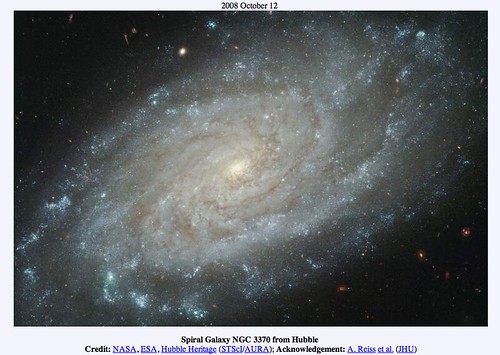
An entrance to a place where your view of the Universe may change... forever.
Saturday, July 16, 2011
In the Interum
It was a FANTASTIC time at the Asian Art Museum... I literally could spend days there just looking at, well, everything. But, I must not be that much of an ubergeek since I couldn't even figure out how to turn off the flash on my digital camera. I finally had some help and figured it out but not after I took most of my pictures from my iPhone. That will have to wait until I get home but I'll try to transfer a few pictures from it to the laptop as soon as I can.
So, as you might have figure, this is not really my Day 7 blog but a stop-gap. I did spend most of the day at the Museum when E.F. called. Luckily when he was home, I was on my way back to his place. I got there and his friend Katrina from Sac was there. We all headed on down to The Mission District to eat (good Pakistani and Indian food, yum!) then went to a showing of archived films (yes, actually films on a projector!) at an event called The Oddball Film Festival even further down in the district. It was fun, but we didn't get home until close to midnight. I swear, E.F. and Katrina are half billy-goat. But, my legs survived and now it's time to get the day started here... Later.
One of the great joys and burdens I have in being a technophile is that I’m always in a learning mode. I discover new applications and new technologies to make my abilities expand, my job better, and give me greater creativity and enjoyment... but the time requirements are tremendous. Luckily I have a few tricks up my sleeve such as Twitter, Facebook, Mac New Network, and other various video and text blogs that I run past each day to help keep me abreast of happenings in the technology world. Still, every time I have a new application to use I have new abilities I have to train myself to master or at least become competent at doing. This can be such a hassle. For instance, I am typing this blog on my new MacJournal app so that I can do it when I have no internet or when getting on the internet is a hassle (such as at work - no way in hell I’m gonna use their network and be bound by their restrictions of internet usage... no way in hell). I’m doing the typical Mac user thing of just trying it out without reading about it much... I’m sure that I’ll have to find a tutorial or a user’s guide and dissect it when I get to the more powerful parts of the application but so far it seems to be a great journal... so far.
I also hope to have a personal website built in the next few months. I’m not going to go fast as I wanna make sure I do it right, plan out each page well, and take the time to learn how to use iWeb. It seems pretty straight forward (as are so many things that Apple produces). But going quickly and producing a piece of shlock is just not my style. The I have a new scanner (Neat Scanner... way cool) but I have to take the time to get all my bills together for this year, scan them, and then learn how to organize them and export them to things like my TurboTax. It’s a lot to learn.
So I'm tweeting and doing my Face Book schtick when I come across a tweet by Phil Plait the Bad Astronomer and his blog on the Discovery Magazine website. It turns out that someone has done me a great favor - a BIG favor. It never fails that when I'm teaching my astronomy unit that when we get to the planet Saturn, the following question always comes up:
"What would it look like if the Earth had a ring around it like Saturn?"
Well, thanks Phil, he and others have found the following video on YouTube that evidently went viral not too soon after it was posted. It is fantastic:
So I'm listening to D.J. Grothe and the Point of Inquiry podcast (and trying to catch up on all the podcasts I've missed when school started again). Then I come across the one titled "What is the Worst That Can Happen?' and it inspires me to go to YouTube to see this guys video. You watch this video and you come to realize that practically all of the arguments that are used to deny Global Climate Change are the equivalent of whistling in the dark to keep the robbers away while walking down a street you should never have taken. Greg Craven is a high school science teacher from Oregon and an activist on Global Warming. He makes a set of arguments that just are not easy to try and shoot down. But don't take my word for it. Watch for yourself and try to shoot it down... this is in fact what Mr. Craven asks us to do... so do it:
So I'm done with blogging today (or so I thought) and decide to sit down and watch the news and 60 Minutes to keep informed. Then, after and interview with President Obama, they come on with this article about 'regenerative medicine.' Now I'm somewhat familiar with the ability of a certain subset of vertebrates to be able to regenerate limbs like salamanders and newts and the tails of some lizards, but not in humans... until, possibly, now. Most of the time when the damage to a human body is too great even for sort of "shop mechanics" surgical techniques, we are left only with amputation of a damaged limb or the need for the transplantation of whole organs (heart, liver, etc.). Then there are all the people who can't get organs in time and die while waiting. If we just had a way to trick the body into regenerating that tissue then many people might not face the amputations or total organ failures to their doom. But we haven't figure out how to do that yet... until, perhaps, now. I ask all my readers to click on the link and to take the time to watch the episode of 60 Minutes. It reminds me of that quote from Shakespeare and the Tempest: "Oh brave new world that hath such people in it." I suggest listening to the segment while listening to "Shapeshifter" from the album Octagon by the group Dilate for the full effect. Check iTunes please.
So I get home, plop down in front of the computers, check my Tweets and Facebook lists, and there is a link to the best article I have seen in weeks from a science point of view; thanks to Brenda on Facebook. So, I click the link to the NPR story and see the best video rendition of what a virus does to the body. I'm gonna use this with my students. I know it will induce a whole series of questions but it's important that they understand the workings of a virus and get out the their heads some of the mystery surrounding how disease works in the human body.
Listening to NPR as I do every day in the morning I heard a great discussion between Weekend Edition Saturday host Scott Simon and Michael Specter a reporter for The New Yorker magazine concerning his new book just out titled Denialism. In the talk he discusses how a group of island residents have stopped vaccinating their children against childhood diseases and how 40% of the children at a school in Marina del Rey got exceptions for vaccinations. His arguments are cogent and timely and make us confront the way we see the world. I am constantly confronted in my work with the insanity that parents and media foist upon our young people (" Is the world really going to end in 2012?" or "Is it true that we came from monkeys?".... Oh come on people!). But Michael Specter's point boils down to the threat that our irrational and denialist thought has for our well being and our continued existence. But why should I try to state the points when the author can do that for himself:
So I get this e-mail from my dad today. Now my dad loves to keep track of the rumor mill surrounding Apple and the Macintosh computers and the Mac OS platform. Today he sends me this picture of an article from MacRumors about the new Google Navigation App for the Motorola DROID phone (the app is currently in BETA mode but still sounds cool). The article tells about how Google hopes to have this free app be a great part of the mobile OS that it calls Andoid which comes standard as part of the DROID phones when they come out in the next few weeks. This is a competitor to the Apple iPhone but I think it will be more different than competitive to the iPhone since the interfaces will be different to a degree. YouTube has a great explanation video for the Google Navigation App and can do a better job of explaining it than I ever could:
Everybody who knows me knows how much I love technology (I know, I know... others would say I have an obsession with widgets, doohickeys, thing-a-ma-jigs, and whatchamacallits), but I really get crazy over anything that can make me more productive and help me with my failing memory as I get older (No comments, peanut gallery). And as such, for several months I have been looking at the product that is pictured to the left which is known as a Pulse Pen and comes from a company called LiveScribe which I think you gadget freaks like I am should really check out. Basically it's a small computer that records everything that's being said around you while you are writing on your paper and thus can play back the conversation or lecture by touching the areas you wrote at the time you wanted to hear what was being said. The small videos at the company website are much better at an explanation than I am but I got mine, have been practicing with it, and it's really COOOOOOOL. Anytime you start up the pen, as you write on the special paper, it remembers what was being said as the writing was going on. Now, you can also take that information and put it on your computer and have it looking just like your notes. THEN... you can play back the conversation/lecture just as if you were there! I got the 2 GB version because I know how long winded teachers can be ESPECIALLY when they are in administrative meetings. The paper, however, can't be just any paper but special paper that allows the pen to know where ON the paper the information was being written. In addition (again) the information can be exported as pdf's and there's free transcription software that you download that allows for the changing of the notes into a printed format. Totally cool. Go ahead! Check out the site and see what technology can do for you!
So I'm watching (or I should say catching up on) my viewing of my favorite technology blog, GeekBrief.tv, and listening to Cali Lewis talk about a bunch of stuff (mostly for me it's ho hum) when she talks about this toy which uses "mind control." Mind control? WTF? So I start watching the rest of the blog and she shows this toy called The Force Trainer which is made by Uncle Milton Industries (with Mattel coming out with a competitor toy around the same time) and which should be out near the end of the summer costing about $130. Bull Pucky! I couldn't believe my eyes.... The toy reminds me of the mind control trainer from that old sci-fi flick from the 50's called The Forbidden Planet which had an alien race called the Krell who had developed a machine with no mechanisms for control... the mind did all the controlling (if you've never seen it, check it out on iTunes sometime).
Essentially, you put on a headset that monitors your Beta Wave functioning and as you concentrate a ball rises up a tube and the more you concentrate the higher up the tube it goes. The Beta Waves of your brain are the waves produced when your brain is in an intense state of concentration. the technology was evidently first developed by DARPA (Defense Advanced Research Projects Agency) who are the folks that gave us such things as GPS and Night Vision but is now being used commercially by a company known as NeuroSky. The potential applications are almost inconceivable:
In sunny California it is almost unheard of for people to not have AC in the summer. I also have AC.... BUT... it's not central but a single small window unit in my upstairs. NOT ENOUGH... especially on days when the temperatures are in the triple digits. I do what I can ( I have plans to insulate my windows on hot days I hope to put into action today) but there are times when I just have to retreat to one room with my dog and hope that I can stand the noise.... Thank goodness for Sling Box so that I can watch the downstairs TV on my computer upstairs.
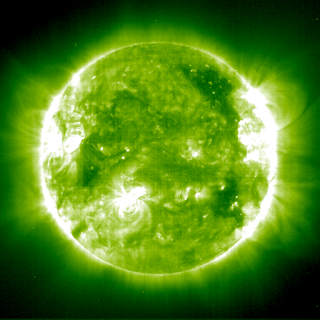
I love the Sun; it just doesn't always like me (skin cancers, sun burns, heat in summer, etc.). But it is an amazing site when you see the surface for the first time (which I was trilled to be able to see as a child one of the first times I looked through a friend's telescope). Consider a few factoids:
1. The sun converts 600 million tons of Hydrogen into 595 million tons of Helium EVERY SECOND and it has been doing so for the last 4 1/2 billion years.
2. If you could capture and use all the energy that the sun emits in ONE SECOND, it would be greater than all the energy ever used by humanity in it's ENTIRE HISTORY.
3. Compared to other stars, the Sun is classified as a yellow dwarf star. Dwarf? YES. The largest star I know of is the star VV Cephei which is so large that if you put it in the same position in the Solar System it would be larger than the orbit of the planet Jupiter!
Chris Anderson is the Editor of "Wired" magazine which is usually a good read if you're a member of the tribe of geek as I am. He has started a new video blog on MSNBC titled IT/IO and has some great interviews with people who are leaders in the information technology community. One of the more interesting interview is one I stumbled upon at the MSNBC website and it's with Marvin Minsky who is well known as an american cognitive scientist at MIT and the co-founder if it's Laboratory on Artificial Intelligence. I found the couple of small videos fascinating especially when he discusses what he is interested in in the study of how humans think and how he distinguishes human activity from activities that can be found in the behavior of all animals of a certain complexity. Take a look at the two interview segments:
For some time now I have been slowly but methodically been planned to put webcams in my place to keep track of things. I suppose this desire and planning traces its origins back to an attempted break-in several years ago and as I have been accumulating "stuff" (OK, OK, I'm guilty of being a vulgar materialist and capitalist... I admit it... now move on) I felt a need to keep track of my domicile. I can't get an alarm put into my place (long, way long story not suitable for this blog) so I started to formulate a solution. Automation! Yup that was the key.
Last summer I upgraded my home system and started to use a Mac Mini with Insteon Modules and Indigo automation software to fool people into thinking I was home when I wasn't and to be able to have the lights turned on when night came and I might be late coming home (I was taking classes at the local community college at night and the winter semester gets pretty dark at 9 p.m.). Then the summers would allow me to turn off and on fans and the cooling system which wasn't centralized and that was a big help. Later on, with the system up and running, I came home from work and heard more than my dog in the house... yeah... I stood still and thought, "What the hell is going on?" I opened the door, confronted two German shepherds that had broken through the back fence and followed my dog into the house through the dog door! The confrontation was pretty easy as I had picked up a big wooden sword near the door (don't ask) and the dogs probably thought, " Holy Shuzzbud - get the frack outta Dogde!!!" and were pretty much gone in 20 seconds. My dog was OK, freaked out, but OK and that was cool... but the place was trashed with mud and all the dog food containers were ripped and spewed crap all over the house. After spending hours cleaning the devastation, I thought, "I won't get caught off-guard again!" and thus came a plan.... web cams.
After much research and many emails to Ben and Spencer at Bensoftware.com, I got Security Spy (THE premier security software for the Mac... and NO F@#*€‹·°king way am I using PC unless I have no choice... more on that later). Serendipity is a great thing as well as Fry's is dumping their stock of Airlink101 network cameras and I got mine for $99 instead of $250! Today I install the last one until I upgrade to 8 cams instead of just 4 on Security Spy (click the link and check it out!) and have the ability to check out the house on my cell phone (way too cool as well)... It's good to be a geek!
Then, I get up this morning, start watching the MSNBCnewsfeed and come across the story of a woman who is watching her house get burglarized (Yeah, check it out!). She calls 911, tells that that she's watching her house be burglarized before her eyes, the police surround the house and haul away 4 would-be burglars one of whom happens to be her next door neighbor (now that's slime if ever I've heard of one). I have no doubts now... never again... I love technology!
While going through my usual morning reads of the Tweets, Blogs, and messages from my Facebook buds, I went to the Richard Dawkins Foundation website and came across this. It has to be one of the most asinine political moves that anyone has done in that state since.... oops, my bad. I forgot... I'm writing about a midwest state like Kansas. Remember the book titled "What's the Matter with Kansas?" Read the whole article on this idiotic resolution against Dawkins speaking on evolution at U of Ok. and maybe that will jog your memory.
Then I get a different article after reading the above one on the legislative resolution. The thought that some dim-witted politician from Oklahoma of all fucking places would decide that free speech needs to be "investigated" just about pushed me over the edge to wanting to do violence! (No, no... don't worry. I won't go there). But finally Dawkins had his say:
I've been away from the blog for a few months now and need to get back to business. I just got a program called Jing which comes for free for Mac users from the Jing Project (google it and you'll see). Was playing around with it's functions and found this:
Comes straight from my Flicker account. Pretty cool eh? More later.
OK, boys and girls, here's your next lesson in planetary astronomy. The solar system can be divided in two ways depending on location or composition of the objects in question (this is when discussing planets, the sun and moons of the solar system are a different story). The location divisions can be done as follows (from the sun outwards): Inner Planets, Asteroids and Minor planets, Outer Planets, Kuiper Belt Objects. Each one of these locations also have the majority of the objects in these areas composed of a particular material (i.e. Kuiper Belt objects are predominantly made of ices from such materials as methane, nitrogen, carbon monoxide, plus a smattering of silicate/rocky materials mixed in). So, mes etudiants, listen up:
I have been contemplating lessons for all my readers in the science of astronomy (yes, you , my two readers out there, can get a free education in astronomy - the princely discipline of science). As such, from time to time, I will be posting lessons on the main topics of astronomy (take notes, there will be an exam on this in the end... or you won't get your certificate of completion and you won't get to join the junior space league...). The best place to begin in my experience is to examine the most visible of the night sky objects, the Moon. Have fun and I'll give you more later:
• So as I am starting my new year, I am using some new ways to post my bogs here on blogger.com by using a hopefully useful little Firefox add-on named ScribeFire. Let's hope I can used to all the bells and whistles this thing has and how to use it effectively. I have put on several add-ons that have so far proven their worth, here's hoping this one does as well.
• It's raining and the wind is howling. Not as bad as it was earlier this morning but 20 to 40 mph winds are still nothing to sneeze at. I am kinda stuck at home hunkering down with my dog and considering my new year's resolutions. Some will seem pretty standard such as getting back into shape (but in my case it's been about a year and a half since I tore 2 muscles in my back and I will have to get them back into some working order before going back to the dojo) but others are more inspired and inspiring. I have been a somewhat musician since I was 8 and have practiced mostly keyboards and violin. This last year I discovered the 'Theremin.' Invented in 1919 by Leon Theremin from Russia, it is the first known musical instrument but is unusual in that you don't touch the instrument when you play it. The most famous player is Clara Rockmore who invented the manner in which to play the instrument and helped Theremin improve the design of the instrument to make it more useful to those playing it. I have fallen in love with the thing.... it sounds like some otherworldly voice and with the addition of other effect from pedal sources, it has great potential. I want one... I want to learn how to play one... I want to perform with one. OK, that's resolution #1. Here is an example of what it can do:
• Resolution #2: for the longest time I have wanted to be able to find and play a Lyricon. It is a Wind MIDI device that was used very effectively by the new age group Shadowfax and I just love the sound of the thing:
And so I have resolved to get another instrument... but the Lyricon, unfortunately is no longer manufactured. What do I do? I research and find the equivalent today which can do even more - The Yamaha WX5 Wind MIDI Controller:
To play it also requires a VL70-m Virtual Acoustic Tone Generator or some other MIDI controllable tone generator, but at least I can get them both from Guitar City and Skips music has one in stock right now. Now comes resolution #3....
• Resolution #3 - I will get a MIDI keyboard that works with GarageBand on the iMac and start to produce my own music that I have sat on for almost 40 years, record it, perform it, and then start to sell my own music (I think I'll need a copyright lawyer to help me). OK! So my mony for the year is now spoken for... hmmmm.
While stumbling through the internet in the 'Astronomy' search mod, I came across a phenomena known as "noctilucent clouds" or NLC's for short. this is a phenomena where the clouds form in the mesosphere of the earth at altitudes of between 80 to 100 km in height (essentially it is on the border between space and the workable edge of the Earth's atmosphere). The picture shows a view of some of these clouds as seen from Earth after the sun has already set and as such they are only visible because they are so high that the observer is on the non-sunlit portion of the Earth while the sun is still able to illuminate these clouds from around the curvature of the Earth's surface. Here are some links that may help for those with a bit more than the average curiosity:
Some of the speculation is that the possible causes are due to meteoric dust that the Earth sweeps up as it rotates and revolves around the Sun (since the particles are just the right size for proper nucleation to occur) while others speculate that it may be an indication of global warming. These clouds seem to have first been noticed shortly after the eruption of Krakatoa whose eruptions of gas and dust caused spectacular sunsets for decades after words. I tend to ask if there might not be a correlation which is demonstrable between the first noticing of such clouds and the upsurge in the industrial revolution. I never have been one for coincidences so I think further investigation is very much warranted. At least for my readers, enjoy the pictures... they are spectacularly beautiful.


 In sunny California it is almost unheard of for people to not have AC in the summer. I also have AC.... BUT... it's not central but a single small window unit in my upstairs. NOT ENOUGH... especially on days when the temperatures are in the triple digits. I do what I can ( I have plans to insulate my windows on hot days I hope to put into action today) but there are times when I just have to retreat to one room with my dog and hope that I can stand the noise.... Thank goodness for Sling Box so that I can watch the downstairs TV on my computer upstairs.