Monday, December 21, 2009

The Morning Dazzle of Ring Around the Planet

So I'm tweeting and doing my Face Book schtick when I come across a tweet by Phil Plait the Bad Astronomer and his blog on the Discovery Magazine website. It turns out that someone has done me a great favor - a BIG favor. It never fails that when I'm teaching my astronomy unit that when we get to the planet Saturn, the following question always comes up:

"What would it look like if the Earth had a ring around it like Saturn?"

Well, thanks Phil, he and others have found the following video on YouTube that evidently went viral not too soon after it was posted. It is fantastic:


Labels: , , , , , , , ,

Monday, July 20, 2009

One small step...

I've been watching the newscasts and history channel and other channels presenting really cool programming on the this the 40th anniversary of Apollo 11 landing on the Moon. It was really great to watch a re-enactment of the moon launch up through the splash down 5 days later. I remember where I was that day even though I was only 7. My family and I were driving back from my great aunts cabin in the Santa Cruz mountains and so I couldn't see the landing but we were listening to the radio as live broadcasts were going on even on the radio and not just television. I still have several of the newspapers that my father bought for that day and I hope to get some type of plastic protector for them (I think more for sentimental reasons than anything else... I know I'll never part with them until I meet my end). I suppose the only thing I find distressing is that such a phenomenal achievement will get only a day or two of some newscasts and most people will go about there way and then promptly forget all about it while someone like Michael Jackson got weeks of seemingly non-stop coverage after he passed away. People's priorities and sense of history is totally screwed up....

Labels: , , , , , ,

Monday, June 29, 2009

Helios Alive!

In sunny California it is almost unheard of for people to not have AC in the summer. I also have AC.... BUT... it's not central but a single small window unit in my upstairs. NOT ENOUGH... especially on days when the temperatures are in the triple digits. I do what I can ( I have plans to insulate my windows on hot days I hope to put into action today) but there are times when I just have to retreat to one room with my dog and hope that I can stand the noise.... Thank goodness for Sling Box so that I can watch the downstairs TV on my computer upstairs.

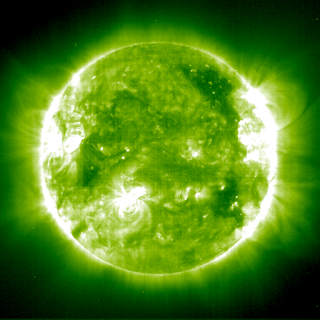
I love the Sun; it just doesn't always like me (skin cancers, sun burns, heat in summer, etc.). But it is an amazing site when you see the surface for the first time (which I was trilled to be able to see as a child one of the first times I looked through a friend's telescope). Consider a few factoids:

1. The sun converts 600 million tons of Hydrogen into 595 million tons of Helium EVERY SECOND and it has been doing so for the last 4 1/2 billion years.

2. If you could capture and use all the energy that the sun emits in ONE SECOND, it would be greater than all the energy ever used by humanity in it's ENTIRE HISTORY.

3. Compared to other stars, the Sun is classified as a yellow dwarf star. Dwarf? YES. The largest star I know of is the star VV Cephei which is so large that if you put it in the same position in the Solar System it would be larger than the orbit of the planet Jupiter!


Labels: , ,

Sunday, October 12, 2008

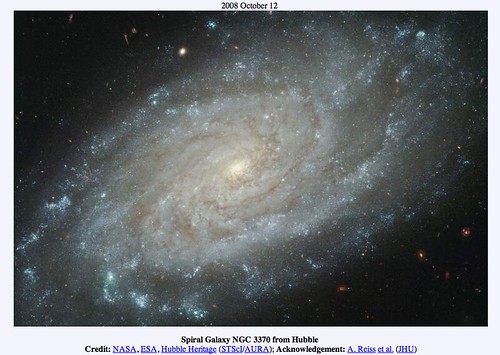
The Beauty of Galaxies

I've been away from the blog for a few months now and need to get back to business.  I just got a program called Jing which comes for free for Mac users from the Jing Project (google it and you'll see). Was playing around with it's functions and found this:

2008-10-12_1055

Comes straight from my Flicker account. Pretty cool eh? More later.

Labels: , , ,

Friday, March 21, 2008

Astronomy 101 - Lesson 2: The Inner Planets


OK, boys and girls, here's your next lesson in planetary astronomy. The solar system can be divided in two ways depending on location or composition of the objects in question (this is when discussing planets, the sun and moons of the solar system are a different story). The location divisions can be done as follows (from the sun outwards): Inner Planets, Asteroids and Minor planets, Outer Planets, Kuiper Belt Objects. Each one of these locations also have the majority of the objects in these areas composed of a particular material (i.e. Kuiper Belt objects are predominantly made of ices from such materials as methane, nitrogen, carbon monoxide, plus a smattering of silicate/rocky materials mixed in). So, mes etudiants, listen up:


Part 1


Part 2

Part 3


Part 4


Part 5

Labels: , , ,

Monday, March 17, 2008

Astronomy 101 - Lesson 1: The Moon


I have been contemplating lessons for all my readers in the science of astronomy (yes, you , my two readers out there, can get a free education in astronomy - the princely discipline of science). As such, from time to time, I will be posting lessons on the main topics of astronomy (take notes, there will be an exam on this in the end... or you won't get your certificate of completion and you won't get to join the junior space league...). The best place to begin in my experience is to examine the most visible of the night sky objects, the Moon. Have fun and I'll give you more later:

Part 1


Part 2


Part 3


Part 4

Labels: , , ,

Sunday, December 02, 2007

Wonders Never Cease...


While stumbling through the internet in the 'Astronomy' search mod, I came across a phenomena known as "noctilucent clouds" or NLC's for short. this is a phenomena where the clouds form in the mesosphere of the earth at altitudes of between 80 to 100 km in height (essentially it is on the border between space and the workable edge of the Earth's atmosphere). The picture shows a view of some of these clouds as seen from Earth after the sun has already set and as such they are only visible because they are so high that the observer is on the non-sunlit portion of the Earth while the sun is still able to illuminate these clouds from around the curvature of the Earth's surface. Here are some links that may help for those with a bit more than the average curiosity:

[1] Noctilucent Clouds (Wikipedia article)

[2] NASA Article : Strange Clouds

[3] Video Clips (copyrighted) of NLC's

Some of the speculation is that the possible causes are due to meteoric dust that the Earth sweeps up as it rotates and revolves around the Sun (since the particles are just the right size for proper nucleation to occur) while others speculate that it may be an indication of global warming. These clouds seem to have first been noticed shortly after the eruption of Krakatoa whose eruptions of gas and dust caused spectacular sunsets for decades after words. I tend to ask if there might not be a correlation which is demonstrable between the first noticing of such clouds and the upsurge in the industrial revolution. I never have been one for coincidences so I think further investigation is very much warranted. At least for my readers, enjoy the pictures... they are spectacularly beautiful.

Labels: , , ,

Saturday, August 11, 2007

Ever wonder about the Moon?

One of the coolest new explanations in recent decades in astronomy has been the ability to use the Apollo data to surmise a possible mechanism for the origins of the Moon. Now with the advent of super fast computing platforms, we can give you a sped up version of the process in the comfort of your own home:


Labels: , ,

Deepest Space

I am reminded of a quote from William Blake when I see videos like the following:

"To see the world in a grain of sand,
and heaven in a wildflower,
Hold infinity in the palm of your hand,
and eternity in an hour..."

The first video shows you where the image was taken,


this next video shows you the galaxies up close with time to reflect

The Hubble Deep Field Image


Labels: , ,

Feeling small... and rightfully so.


The following is a Youtube video of the relative size of planetary and stellar objects as we know them in the Universe so far today. We start with the planets in the Solar System (in order of size from smallest to largest) and then work our way up to the Sun. From there, we go to stars that are higher up on the Main Sequence to the blue giants, the orange and red giants and then to the super giants such as Betelguese in the constellation of Orion the hunter. Feel small.... very small... because you are:


Labels: , ,

Wednesday, April 04, 2007

The Stars Like Dust...

While watching a science video with my students, the narrator was discussing the odds of finding life in the Universe and how we have been at it for a very short period of time. Then, the narrator states, "For every grain of sand on the Earth, there are a million stars in the Universe." I was stunned at trying to comprehend such a truely incomprehensible number. To say that it is mind blowing is an understatement of monumental proportions. I remember answering this question once,"How many stars are there in the universe?" and the only answer I could come up with was, "There are more stars in the Universe than there are grains of sand on all the beaches on all the Earth." Even this statement is somewhat understated when one sees pictures that come from the Hubble Space Telescope and the ability it has to peer deeply into the Cosmos. The picture I include here is from Hubble's Advanced Camera for Surveys and was taken over 40 hours in September 2003. There are about a dozen foreground stars but the rest of all the "dots" in the picture are galaxies. Dozens upon dozens of galaxies in an area that at first seems to be blank and devoid of any bright objects. Incroyable.
And now I am sitting in my house listening to Jon Serrie's song for a planetarium show... space music... "The Stars Like Dust".... The Universe is a mystery sometimes.

Labels: , ,

Thursday, August 03, 2006

Meteor - Not At All Uncommon


Next, we find out from science that the occurance of meteor impacts is not nearly as uncommon an occurance as most might think. Luckily, the Earth has a wonderful atmosphere that protects us in a multitude of ways. I wonder if the cop in this police cruiser noticed the event and that's how the video was saved?

Made you think again...

Labels: ,

Apocolypsis - A Revealing


There are times when the revelations of science are far more emotional and heart-rending than any biblical quotes can be. If you wish to know of the end of the world (or AN end), watch this video: a 500 mile wide asteroid/planetessimal strikes the earth; it is the most accurate depiction of such collision I have ever seen. And now for the biblical quote:

"And I looked... and I saw a pale horse; and he who sat upon him, his name was death... and hell followed with him."
Revleation 6:8

Made you think....

Labels: ,